
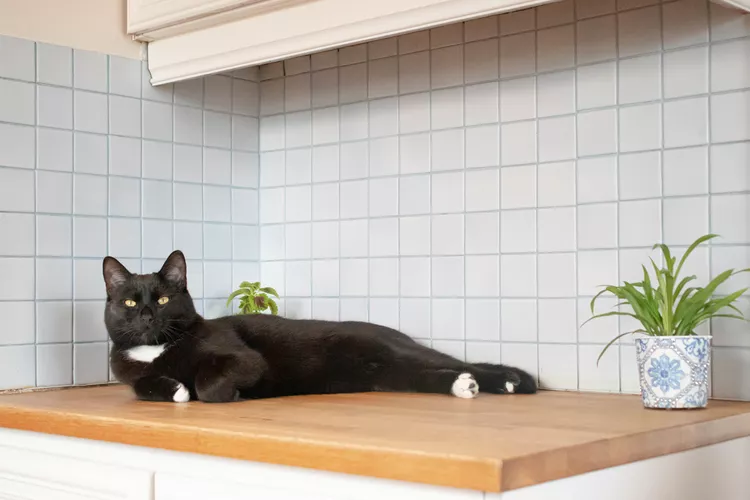
Keeping your cat off the kitchen counters isn't just a way to prevent spills—it could also help prevent injury for your cat and maintain an overall safer environment in the home. Cats who frequently jump on kitchen counters can inadvertently create a number of problems, like injuring themselves while walking on a hot stove or ingesting foods that are toxic to animals.
But the behavior can also create hazards for humans, by tracking waste onto counters if they walk on them after using the litter box and spreading bacteria across the area where food is prepared.
So, how does one try to keep their cat on the ground level? The easiest way is to use a mix of deterrents and rewards.
Why Do Cats Jump on the Counter?
Kitchen counters attract cats for several reasons. Once you identify the reason your cat likes the countertop so much, you can use this information to modify or redirect your cat's behavior.
- Cats love heights. Get any two cats together with a climbing tree or cat tower, and you'll have a ready-made game of "King of the Hill." Countertops are just high enough so that most cats can either jump up from the ground or get help from a well-positioned chair.
- Kitchen counters smell good! They're often loaded with tempting things to eat, such as raw chicken parts, ground beef, milk, or yesterday's tuna casserole that's ready to be reheated for dinner. A carelessly cleaned countertop may also be home to crumbs and spills that a cat might enjoy nibbling on.
- Cats like fresh running water. Some cats are also attracted to running water in the kitchen sink, and for many cats, this is their main source of drinking water. Although the kitchen sink is probably cleaner than the toilet, there are better alternatives for your kitty.
- Cats are curious. We all know the adage about curiosity and the cat. But the truth is, a cat's curiosity is a mark of intelligence. When it comes to counter-jumping, many felines are just looking for answers. Particularly for those cats who are indoor-only, the counter provides a new area (and new smells, sounds, etc.) to explore.
How to Stop Counter Jumping
Employing a few training techniques will encourage your cat to stay off the countertop. These have proven to be successful, but you must maintain consistency if you want your cat (or cats) to get off and stay off the kitchen countertops.
Try the method that works best for your situation or that your cat responds to most positively.
- Apply sticky tape to the edge of the counter. Cats hate the feeling of sticky tape, so once they feel the tape on the edge of the counter, they'll likely be discouraged from jumping on it after one or two tries. The disadvantage is that you may have to keep reapplying the tape indefinitely and the adhesive may be difficult to clean up afterward. Also, the cat may outsmart you and find a way to get on the counter by avoiding the edge.
- Tape a strip of crinkled aluminum foil along the counter. It's not only the feel of foil on their toes but the noise that deters cats. Be aware that this method may be disruptive to the way you use your countertop and may also be wasteful. Placing cookie sheets on the counter, so that they make a loud noise when a cat jumps on them, can also work.
- Use clicker training. Cats respond best to positive reinforcement rather than punishment. If you see your cat on the counter looking for food, offer a treat or other reward such as throwing a toy on the floor near the counter, to entice them off. Once they jump off, pair the reward with a clicker that makes a sound. Eventually, your cat will associate the clicker with the reward and the clicker can be used by itself to lure your cat off the counter.
- Eliminate the chair. If your cat can only get on the countertop with help from a chair, move the chair and eliminate the boost.
- Provide legal jumping targets. Invest in (or build) a climbing tree or a cat tower for your kitty. Make it interesting enough to hold the cat's attention, and once in a while, "sweeten the deal" by hiding a tasty treat at the top. Pet and praise your cat when it uses the climbing tree, so it will associate the new kitty furniture with positive feelings.
- Keep your countertop clean. Remove some of the temptations by not leaving food, crumbs, or other treats on the counter that your cat may be drawn to. Try wiping it down after every single meal, or at least once per day, to ensure it stays clean and free of anything that could resemble a treat.
- Address the faucet. If your cat is constantly drinking at the faucet, figure out if there are stressors around the water bowl (is it near the litterbox, near a highly trafficked area, etc.) and eliminate the stress. Your cat may prefer the cold, fresh water from the tap, so replace their water a few times a day and add an ice cube or two to keep the temperature down. Never leave the faucet running; it's wasteful and tempting for the cat. You can also buy a kitty water fountain that will keep the water in the bowl flowing.
- Provide them with toys. If a cat is jumping on the counter to satisfy its curiosity, it could be a sign of boredom. Providing a cat with toys on the ground level (or something like a multi-level cat tower) can offer them a distraction from the counters.
By using a little ingenuity and staying "one jump" ahead of your cat, you should be able to discourage your kitty's counter-surfing habit.
What If You've Tried Everything?
If nothing seems to work despite your consistency and effort, it may be time to call in a feline behavioral therapist. In this type of situation, the specialist will likely visit your home to assess the situation and come up with new behavior modification techniques to help you keep your cat off the countertop.