
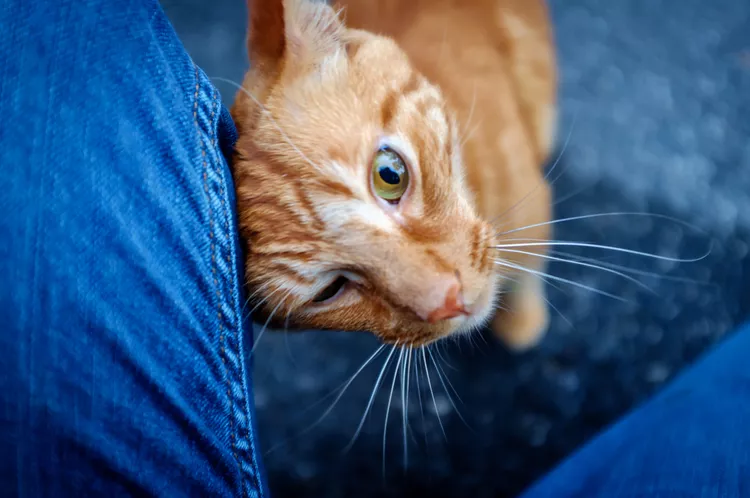
Just what is your cat trying to tell you when it rubs up against your legs? While there can be different meanings behind each incidence of the behavior, this is generally a sign of their love and devotion to you. There are, however, many different specific reasons why your cat might continue this behavior.
Claiming Their People and Environment
Cats rely heavily on their sense of smell to get information about the world around them. They have glands in their chin, cheeks, forehead, and even in their paws that secrete a pheromone. This pheromone is odorless to humans, but other cats and animals can easily smell it. These pheromones tell other animals a lot about the cat that left them behind.
This can include whether the cat is male or female, if it's intact, if it's in heat, and even the mood the cat was in at the time. When you come home from work or running errands, you may have other smells lingering on your skin. Depending on where you came from, your skin and clothing may even have the smells of other animals present. When your cat rubs up against you, it could be attempting to leave its scent on you, as a way of marking you as theirs.
In other words, the cat is letting other cats and animals know, "This human belongs to me!" This is a type of territorial behavior that indicates a bonded relationship. Other territorial behaviors include scratching things and urine marking. Pheromone diffusers such as Feliway provide appropriate things for your cat to scratch, and neutering male cats can help mitigate these more destructive behaviors.
An Invitation for Pets and Attention
When your cat starts frantically rubbing against your legs when you walk in the door after a long day at work, your cat is probably wanting attention from you. It could just be that your cat wants its dinner but it could also be that they want to play or they want to be pet. Cats that specifically want to be pet may exhibit a specific type of face rubbing called bunting or head bunting. This behavior literally is your cat rubbing their face on you and it's their way of asking for head scratches and pets. If your cat rubs up against your legs, offer your hand to them. If your cat head bunts your hand, they're probably rubbing against your legs because they want to be pet.
Some cats may not be as appreciative of petting, though. This is why, even if the cat is actively rubbing against you, you should first try to elicit a head bunt. Some cats may also get overstimulated with too much petting. Think of the meme of the cat that allows exactly three pets and then pounces on your hand. Try to limit pets to head scratches or the rump/tail base area as opposed to petting all down their back like you might do with a dog. Cats that are reaching their petting limit may go from relaxed to attentive and may even turn their head to watch you petting them or to sniff your fingers.
Showing Their Affection
As previously mentioned, head bunting is a common behavior that, when done on a person, is usually an invitation for pets. It is also a behavior denoting that the cat feels safe and secure around the person it is head bunting. When done on inanimate objects, it means that they are happy and content in their environment. Confident and cheerful cats will also have a soft face with no tension around their eyes, ears, or whiskers. It may also offer a few slow blinks. It will have a loose body as well, sometimes laying comfortably on its side or back.
Cats can rub up against your legs for a few different reasons. Whether it's a way to scent mark or a way to elicit your attention, though, it's generally meant as a behavior of affection. So the next time your cat tries to trip you on the stairs because it keeps getting underfoot, just remember, that it is doing it from a place of love.