
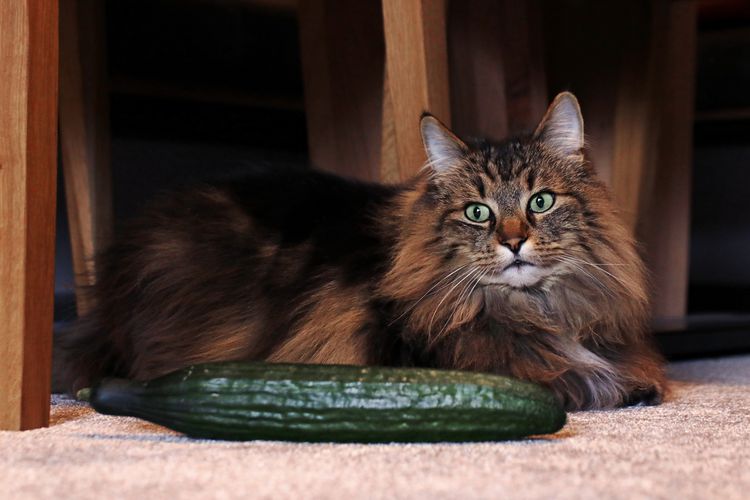
You may have seen videos online of people scaring their cats by quietly placing a cucumber behind them. Then, when the cat turns around to see the cucumber, they are startled and jump back, much to the delight of the person filming. The first time you see a video of a cat being scared by a cucumber you may think that it's just a fluke. After watching multiple videos, though, you may start to wonder, why are cats scared of cucumbers? You may even wonder if your own cat will be scared of a cucumber placed behind them.
Why Are Cats Scared of Cucumbers?
The cat food industry likes to drive home the fact that cats are predators. But a lot of people forget that cats are also prey. In fact, cats can be a prey species to a lot of other animals. So cats inherently don't like things sneaking up on them. This is why cats have a sensitive sense of hearing, smell, and vision. In fact, cats have a much more sensitive sense of smell and hearing than dogs. If your cat turns around to see something close behind them that wasn't there before, they will initially be startled. This reaction can be exacerbated if the cucumber is placed while your cat is eating and drinking or while they are using the litter box. Both of these activities leave your cat vulnerable. This is because a cat that's eating, drinking, or even using the litter box isn't paying attention to their surroundings as well as they normally would. A cat that is using the litter box can't run away as quickly or as easily either. Being startled by a potential predator during any of these activities is especially stressful for you cat.
Are Cats Scared of Cucumbers Because They Resemble Snakes?
A commonly held belief is that cats are frightened by cucumbers because they look like snakes. At first glance it makes some sense: cucumbers are long, narrow, and they even have a bit of a curve to them like a snake would. Some people like to think these characteristics make
cucumbers snake-like. So when your cat turns around and sees not just something that seemingly appeared out of nowhere, but something that also looks remarkably like a snake and then jumps in terror, these people argue that it's because your cat thought it was a snake.
Of course, after the initial jump scare, most cats will realize that the encroaching predator is really just produce. In fact, if you place the cucumber in front of your cat, as opposed to behind them, they won't jump back in fear because they will know that it's not a predator at all. The other problem with the snake hypothesis is that most cats are actually curious about snakes. If they find one in the garden (or in your house) they may paw at them and think they are aren't too dissimilar to their favorite string toy. Unless they've actually been bitten by a snake, your cat may not realize a snake is something that can hurt them. So while cucumbers resembling snakes being the cause for the terror seems like a fitting idea on the surface, your cat is probably more frightened at the prospect of something sneaking up on them, rather than something that looks like a snake sneaking up on them.
Should You Be Scaring Your Cat With Cucumbers?
After watching the tenth video online of a cat being scared by a cucumber, you may be giddy with laughter and wanting to try it out on your own cat. But like people, cats don't appreciate jump scares. That adrenaline rush can cause feelings of stress and panic. If a cat is subjected to it repeatedly, they may even become anxious around you or around mealtimes. They may stop eating their food or they may stop using their litter box. Your cat may also injure themselves and/or break something in their initial panic when they turn around and see the cucumber hiding behind them. Plus, it's just mean to scare your beloved cat with a cucumber.
So, while those videos of cats being scared by cucumbers may initially seem like something fun to try with your own cat, instead get them a catnip toy shaped like a cucumber and share in a play session together.